
Blog
What an AI-Native Person Is Actually Like
Since I started building large-language-model applications in 2023, I’ve grown more and more sure of one thing: the people who adapt to AI fastest are usually not the most technical.
An observation that keeps coming back
For the past few years I’ve been working on products built around large language models. The more I see, the more one thing jumps out at me: the people around me who pivoted fastest, who use AI the hardest, are almost never the most technically skilled. Flip it around, and you find plenty of engineers, designers, and experts who were enormously successful in the previous era but who, faced with AI, turn hesitant, resistant, even unable to make much use of it at all.
At first I figured this was a matter of tool fluency. Learn to type, learn to click the buttons — who can’t do that? But the more I thought about it, the less that held up. The real dividing line isn’t the tools. It’s something further down: what you assume, by default, about the world, about yourself, and about AI.
So I want to take a serious crack at one question: what is this so-called “person of the AI-native era” actually like? This essay is me thinking that question through to the end.
Every generation of “native” people differs not in tools but in default assumptions
Let’s pull the timeline back a bit first.
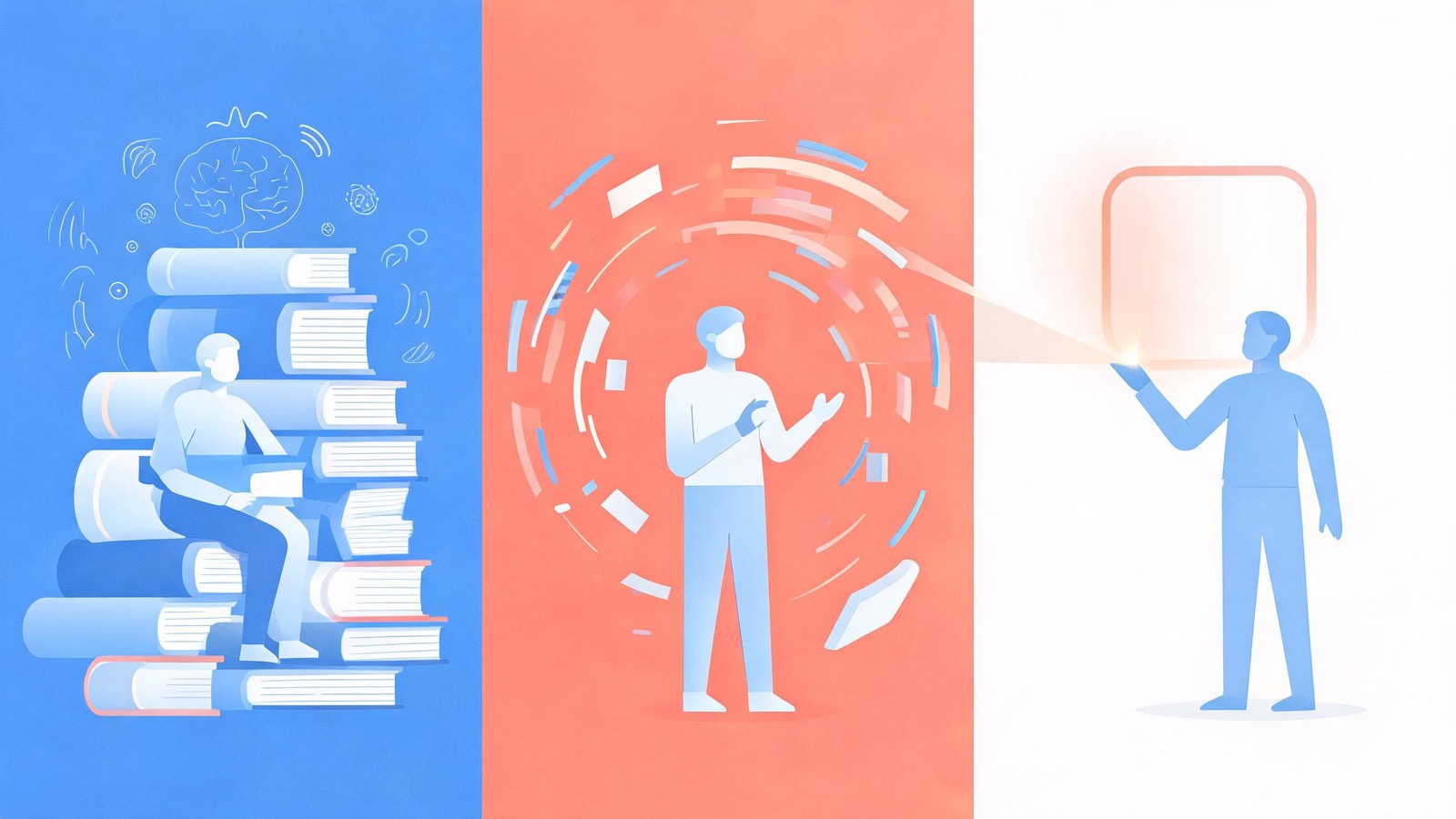
People before the internet operated on the assumption that knowledge was scarce and acquiring it was costly. A book, a document, a person who actually knew the thing — none of these were easy to come by. So the core skill of that generation was memory and internalization. How much you’d stuffed into your head basically decided how much you could do. The bottleneck was getting information.
For internet natives, the default assumption changed. It became: information is abundant, I can look anything up anytime. So the core skill shifted from memory to filtering and judgment. You didn’t need to memorize the answer, but you did need to know how to search, and how to tell which source was trustworthy. The bottleneck moved from acquisition to filtering.
In the AI era, I think something more fundamental snapped into place. The default assumption became: capability can be acquired on demand. Not “I’ll go learn it,” not “I’ll go find someone who can,” but “I can do it right now, by describing clearly what I want.” The bottleneck migrated again — from filtering information to expressing intent precisely. How accurately you can say what you want now determines what you can make.
The line is clean once you string it together. Each generation’s core skill goes from memory, to search and judgment, to defining the problem and expressing intent. Each time, human value moves one rung further upstream.
Why the winners of the last era are the slowest to turn
Once you see that line, the counterintuitive thing makes sense.
A lot of the people who succeeded in the previous era were, in fact, never really asked to figure out what they themselves wanted. That sounds odd, but think about a senior programmer’s day: take the requirement, break it down, use technology to build it. Their edge is in the how — how to take a known goal and realize it in the most elegant way. Same with a designer: the client says “make it high-end and impressive,” and through experience and taste the designer translates that fuzzy phrase into something concrete.
Notice this: the reason these people were valuable under the old paradigm is precisely that they turned “the stuff other people can’t articulate” into their own moat. “You don’t have to think it through — I can think it through for you, and build it.” That sentence is the source of their entire value system, their identity, their pricing power.
Now AI shows up, and that whole layer — translate, then execute — starts getting compressed fast. Which raises the question: when you’ve spent ten years building an identity around “I understand how to do this better than you,” and somebody suddenly tells you the how isn’t scarce anymore, what’s your first reaction?
For most people, the reaction isn’t “great, now I finally get to work on the upstream problems.” It’s to instinctively deny that the change is even legitimate. The code AI writes is no good. The designs it makes have no soul. The copy it writes has no warmth. There’s a grain of truth in these judgments, but the emotion driving them is, at bottom, identity defense.
We usually call this “not being able to climb down off your high horse.” I’d describe it more precisely: identity and skill are bound too tightly together. Inside the sentence “I’m an excellent programmer,” the word “programmer” is both a job and a self. When AI lowers the barrier to programming, what the person feels isn’t “I got a handy new tool” — it’s “the question of who I am suddenly has no answer.” That’s not a learning problem. It’s an existential one. What it calls for is a goodbye, not an upgrade.
From Workflow to Agent: a story about who deserves to be trusted
This section gets a little into the weeds of my industry, but I’ll try to keep it clear, because it illustrates the point unusually well.
When large language models were first being used to build applications, the mainstream approach treated the model as a single “function” inside a program: you’d hand it a fixed set of instructions (the jargon is “system prompt”) and have it do something that previously either required complicated algorithms or was simply impossible to code by hand — understand a piece of natural language, make a judgment call, sort things into categories.
Pretty quickly people found a single “function” wasn’t enough, and a thing called the Workflow appeared. A human first breaks a task down into a flowchart — do this in step one, do that in step two, if this happens go left, if that happens go right — and the AI’s only job is to execute certain nodes inside the chart. Coze (a product from ByteDance, the company behind TikTok) was the classic example a couple of years ago: you drag and drop to assemble the flow, and the AI does the grunt work inside it.
There was an argument going around the field at the time: which is better, Workflow or Agent? An Agent is the other approach — you don’t draw a flowchart, you just give the AI a goal and some constraints, and it decides everything itself: which way to go, what to look up, which tools to call, how many steps to take.
What I eventually understood is that this argument was only superficially about technical architecture. Underneath, it was a philosophical question: who deserves to be trusted more, the human or the AI?
The Workflow architecture assumes the human is smarter than the AI, so the human plans the path and the AI just executes. That was reasonable in 2023 and 2024, because the models genuinely weren’t strong enough yet. But there’s a deeper layer: this architecture gives all those years of accumulated experience, and all that “software engineering methodology,” somewhere to live. The more complex your flowchart, the more branches it has, the more it proves “the AI can’t make these calls — I have to.” Workflow was, in a sense, the empiricist’s comfort zone. It kept the how valuable.
The essential shift with an Agent is that you hand over the how too. And the psychological barrier there is much higher than the technical one. You have to be able to stand not knowing the process. For someone who’s been trained on determinism and control for ten years, this is almost a challenge at the level of faith.
By 2026, today, we barely talk about Workflows anymore. What actually took off this year are the “coding Agents” — Claude Code, Codex, that family. You give one a task at the command line, and it goes off on its own to read the code, think, edit files, run tests, and finish the job, like a real engineer working in a room. Personally, I think this is the year that genuinely deserves to be called the dawn of the Agent.
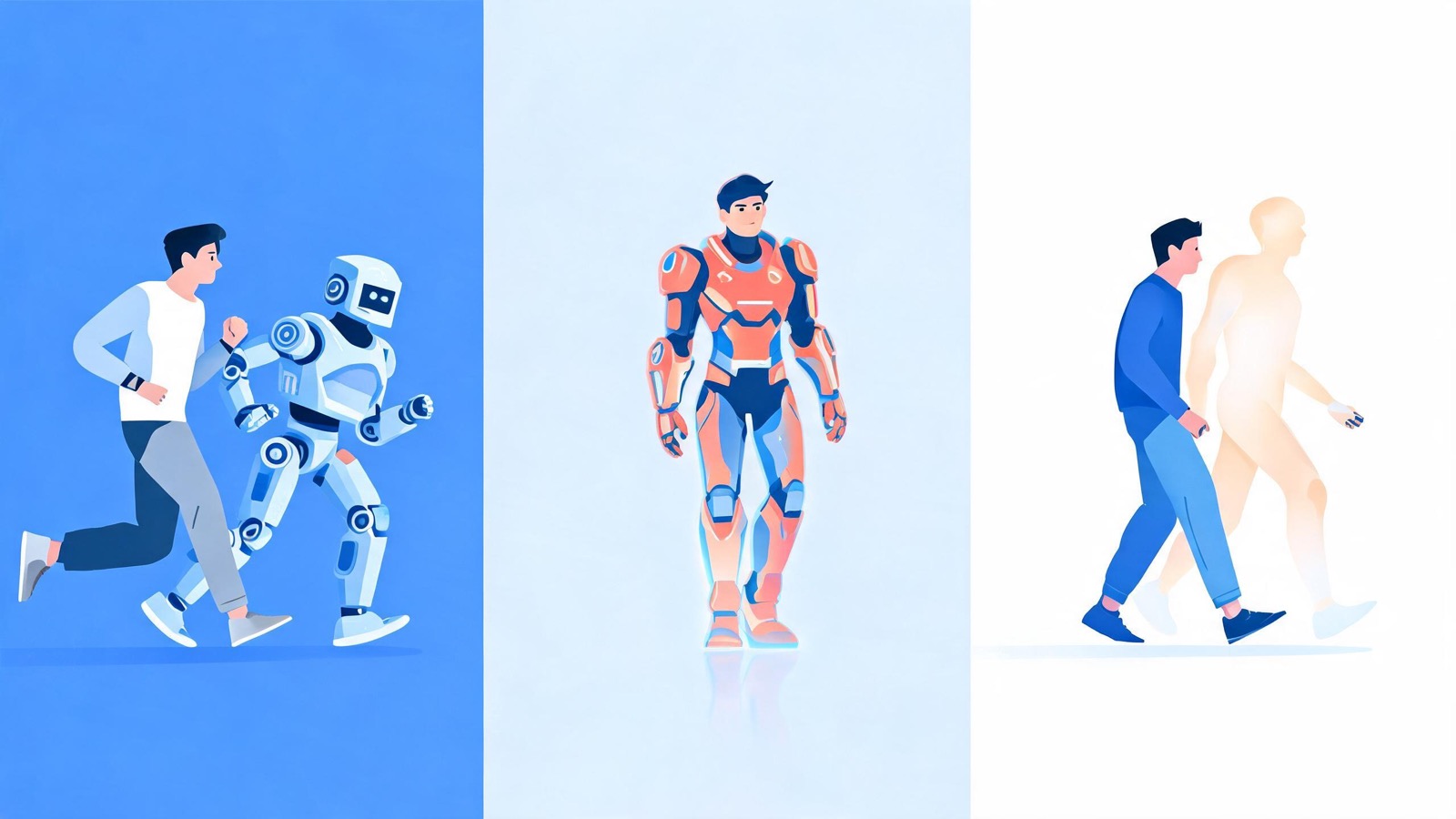
As for how a person regards AI, what I’ve observed sorts roughly into three layers, like a spectrum of evolution.
The first layer: “AI is beneath me.” This person is still competing with AI over who’s better. The trouble is, they’re racing something that’s evolving orders of magnitude faster than they are. The outcome is already decided.
The second layer: “AI is my armor.” This is already a big step forward. You stop competing with AI and start folding its capabilities into the boundary of your own. The whole reason Claude Code took off is that developers put on the armor — one person can do the work of a team.
The third layer: “AI is my partner.” This has a subtle but crucial difference from “armor.” Armor still carries the implicit assumption that “I’m the subject, AI is the tool, I set the direction.” A partner means you grant that AI might, on some dimensions, see things more clearly than you do — and you’re willing to let it push back on your judgment, your direction, even your definition of the problem itself.
That last jump is the hardest. The first two don’t bruise your ego — “AI is beneath me” doesn’t bruise it at all, and “AI is my armor” actually inflates it. Only at the third step do you have to face the real question: if AI is better than me at a lot of things, then where exactly does my value lie?
So what is an AI-native person actually like
After that long detour, I can answer the question I opened with.
An AI-native person isn’t fundamentally “the person most fluent with AI.” It’s the person who knows how to collaborate with AI to get a result. They don’t treat AI as a calculator where input A reliably yields output B; they treat it as an extraordinarily smart, extraordinarily well-read collaborator. Here’s a possibly offensive admission: a lot of what I know now, I learned from the model. I don’t need to know more than it does about every single thing.
If I had to pull out a few concrete traits, here’s what I’d name.
First, a tolerance for not knowing the process. A lot of people use a large language model like a search engine, and the root of that is this: a search engine hands you ten links and you stay in control the whole way; a model just hands you an answer, and you don’t know how it got there. People who can accept that opacity turn the fastest. People who can’t stay stuck on “how do I verify it’s right,” and then retreat to their old methods.
Second, a habit of thinking in natural language rather than in flowcharts. Many people with technical backgrounds have an if-else tree in their heads, and when they talk to AI their instinct is to break the requirement into explicit steps first and then feed it in. An AI-native person just says “here’s the effect I want” and lets the AI do the breaking down. The difference looks small, but behind it are two completely different cognitive habits.
Third, a willingness to learn from AI’s output, and even to correct themselves. When they see its judgment, they don’t rush to prove it wrong — they flip it around: is there a blind spot in my thinking? Admitting you’re worse than a model in some domain is, for a lot of people who make a living on “I know more” — teachers, consultants, doctors, senior engineers — a matter of dignity. But that’s exactly the jump.
Fourth, and most central: the ability to think at the level of what to want. The old education and career systems basically only trained us to solve problems other people had defined. The teacher hands out the questions, the company hands out the tasks, and we compete on the how. The real leveling of the AI era isn’t “everyone can write code” — it’s that the question “what do you actually want, what problem are you actually solving” gets handed, for the first time, equally to everyone.
This also explains why the fastest to pivot tend to be product managers, independent creators, and founders of small teams. Not because they’re technically strong, but because they already think from intent outward — skill was only ever a means.
This is quietly redefining education
Follow this thread and you can’t avoid education and the next generation.
Looked at purely through the lens of exam-oriented education — the rote, test-driven schooling that dominates in China and much of East Asia — a lot of it is genuinely obsolete. Memorizing facts, plugging into formulas, chasing the one standard answer: a large language model can do all of this, and do it better than a person. Keeping students trained on these dimensions is basically wasting their lives.
But let me say something fair, too: there’s one thing in that kind of education that’s badly underrated. It trains a kind of discipline — the ability to stay focused under constraint for long stretches, to gnaw at a hard problem you dislike until you actually understand it. That toughness, that habit of deep thought, is more scarce in the AI era, not less, because AI makes everything come too easily, and the natural human tendency is to stay shallow: ask a question, grab the answer, leave. The people who can actually push AI to its limit are exactly the ones who can sit down and think hard about “what am I really asking?”
So the question isn’t “should we scrap exam-oriented education.” It’s that the core it’s meant to train needs to be redefined: away from the how (hand that to AI), and toward finding and defining the problem, judging which solution is better and why, and one thing that’s especially easy to overlook — actually doing things with your hands in the physical world, actually living through them.
A word of warning for parents here. Lately I keep hearing this plan: get the kid a computer, install some AI, and let them hand their homework, their studying, even their feelings and their worries, all over to AI to sort out. The first half I agree with. Get a kid used to collaborating with AI in natural language from a young age, hand it every cognitive problem, and by twenty they’ll be far ahead of their peers at expressing intent. That’s a real, concrete head start.
But “hand the feelings and the worries to AI too” — here I have to be dead serious: that is precisely the part you should not hand over. Not because AI comforts badly, but because emotional capacity itself can only grow in the friction between people. A kid fights with a classmate, goes home, talks to the AI, and the AI helps them analyze, comforts them, offers advice. But what they’re actually missing is the experience inside that conflict: learning to read the other person’s face, learning the awkwardness of apologizing, living through the full arc of a relationship breaking and being repaired. None of that grows without real human interaction.
I have a very direct sense of this myself: the reason I can think a lot of things through isn’t that my tools are powerful — it’s that over twenty-some years of real life I accumulated enough experience, intuition, and a feel for which problems matter. AI just helps me activate and structure that raw material. If a kid only ever talks to AI, and never banks that raw material in the real world, the quality of their conversations with AI will be low. It’s not that the AI is failing. It’s that they have nothing to activate.
Who will society pay a premium for
This lands on the most practical question of all: when AI becomes as universal as today’s internet, reaching billions of people, who will society pay top dollar for?
First, get clear on why today’s white-collar worker is paid well. The white-collar job only emerged after the Industrial Revolution. At its core, it’s a company organizing a batch of people so that each functions as a stable unit of output, then stringing those outputs together to create value. And the white-collar premium isn’t because the work is more “important” — code shipping on time and a food delivery arriving on time matter equally to their respective users. It’s two structural reasons. First, information-processing ability has been scarce over the past few decades; it takes years of education to develop, so the supply is limited. Second, white-collar output can be amplified through digitization — one programmer’s code can serve a hundred million people. Scalable scarce ability: that’s the formula behind the white-collar premium.
What AI is doing is demolishing the first term of that formula. When anyone who can describe a need, plus AI, can write code, run analysis, do design, the supply explodes and the price has to fall. This isn’t speculation; it’s a basic law of economics.
So where does the future premium flow? My read is that a few new axes are emerging.
One: judgment that can’t be copied. AI can generate a hundred options, but deciding which one to pick, why, and what counts as “good” in this specific situation — that judgment comes out of one person’s entire life experience, values, and taste, and fundamentally can’t be standardized and reproduced. This is exactly why the ability to define the problem keeps getting more valuable.
Two: the scarcity of the physical world gets repriced. Delivery riders, electricians, caregivers, soldiers — these jobs require a real person operating in a real space, and no matter how strong AI gets, it can’t replace them. Deeper still: the intuition built up from long interaction with the physical world — the veteran electrician who glances at the wiring and just knows “there’s going to be trouble here” — is the kind of data AI finds hardest to acquire. When AI drives down the cost of digital-world work, physical-world labor becomes a relatively scarcer resource. I’m not saying delivery riders will out-earn programmers, but the gap is going to narrow. In a sense, it’s a justice that arrived late.
Three: the premium on trust and influence will rise sharply. When everyone can produce professional-grade content with AI’s help, the content itself stops being worth much, and “who said this” becomes enormously important instead. The same sentence, said by someone with a million followers versus an anonymous account, lands a hundred times differently — and in the AI era that gap will only widen. Because when ability gets flattened, a person’s own credibility becomes the only differentiator.
Follow this through, and the two kinds of people with the highest future premium are most likely these: one who creates irreplaceable experiences in the physical world — the top chef, the brilliant surgeon, the person who can make you genuinely feel understood; and one who holds high trust and influence in human society, whose value lies not in what they can personally do but in the fact that a single word from them moves resources and changes other people’s decisions.
I also want to be honest: this isn’t a purely optimistic story. What’s going to get compressed is the vast middle layer of white-collar workers who live entirely on “I can do this task.” It’s not that these jobs vanish — it’s that once AI can cover eighty percent of their work, their bargaining power is down to the remaining twenty. Not everyone can become a “person who defines problems” or an “irreplaceable physical-world expert.” In the process of that middle layer being thinned out, a lot of people are going to suffer, and that needs policy, education, and a social safety net to keep pace — it shouldn’t be waved away with a breezy “embrace AI.”
Where it lands: productize yourself, and be a living person
By this point a particular ability has surfaced: turning your own capabilities into a product.
Today’s white-collar workers actually do something similar, but most of them haven’t really scaled themselves — they’ve just been scaled by someone else. The programmer’s code serves a hundred million people, but the returns from that scaling go to the company; what they sell is still time, just at a higher unit price. The ones who actually capture the scaling dividend are the people who can turn their own abilities into a product.
AI has created a huge change here: the barrier to productizing has been pushed to a historic low. It used to be that if you had a good idea and wanted to turn it into a product, you needed a team. Now one person plus AI can get it working end to end. The path of “spot a problem, define a solution, build a product, serve a lot of people” is, for the first time, genuinely open to an individual.
But here’s the part that’s easy to miss: the core of productizing isn’t “building it,” it’s “knowing who you’re building it for and why they’d pay.” AI can help you build the thing, but it can’t stand in for you in understanding another real person’s pain and needs. The reason I can come up with a few product directions in the foreign-trade industry isn’t that I’m technically strong — it’s that I genuinely understand what the people in this industry are losing sleep over every day.
So this whole chain of thinking actually points at a single conclusion.
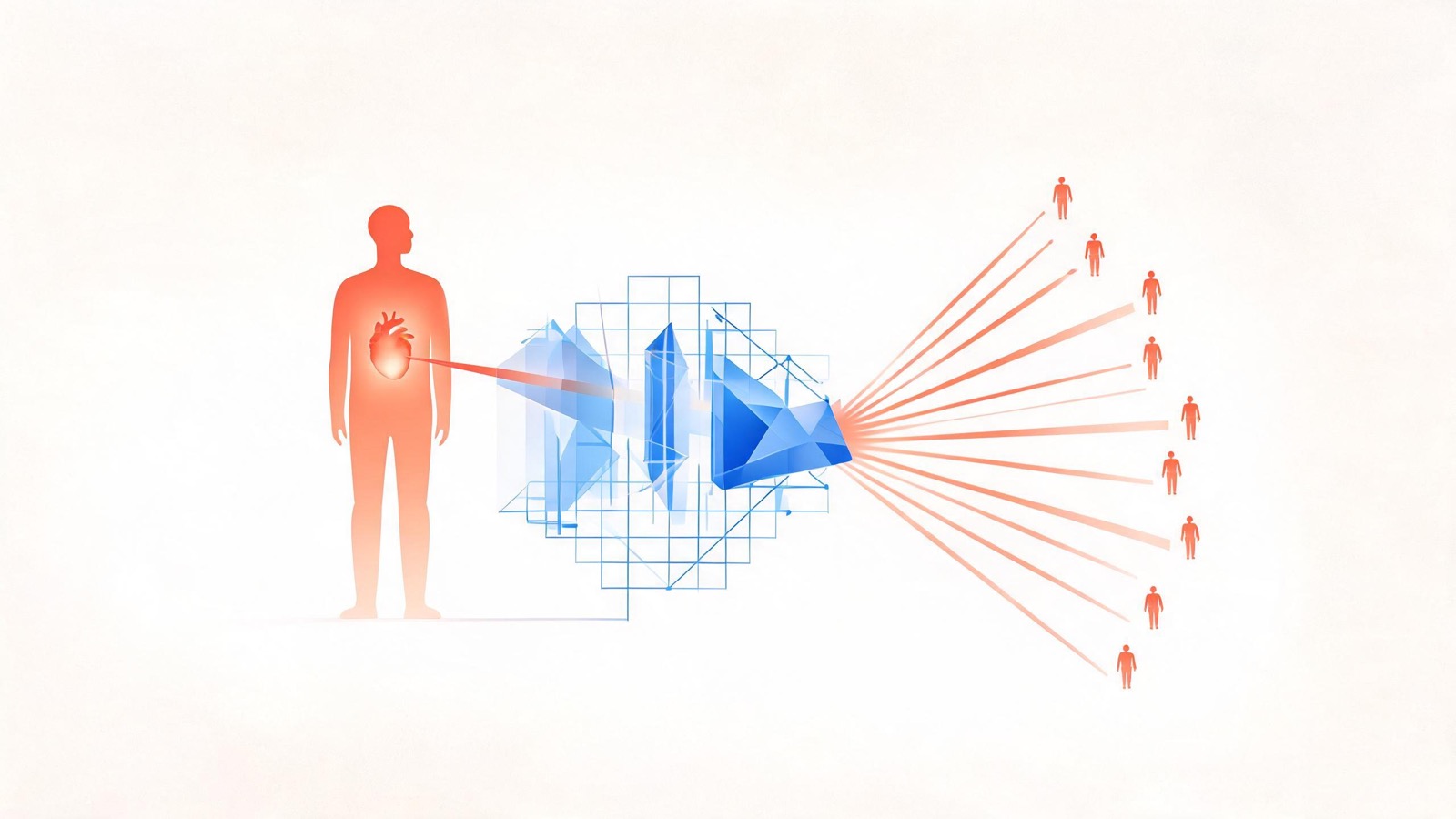
The most valuable person of the AI-native era is the one who can take a deep understanding of the real world and, through AI, amplify it into a product for a lot of people. The understanding, you earn by actually living. The amplification, AI helps you do. Two legs — lose either one and you can’t walk far.
And have you noticed that the two main threads this essay traced — “able to define problems” and “able to build trust and influence in human society” — point at the same root: whether this person has a real self. Defining a problem presupposes that you know what matters to you, that you have your own view of the world. Earning someone’s trust presupposes that you have real feelings and stable values, that the other person can feel you’re real. Neither of these can AI replace, nor can it fake them.
Which leads to a slightly counterintuitive conclusion: the more powerful AI gets, the more valuable it is to be a real person.
Before AI, a person could hide behind their skills. Good code, a beautiful deck, fluent English — these were masks and armor. Other people didn’t need to know who you were, only that you could deliver. Plenty of people spend a whole lifetime using skills to dodge the questions of “who am I, what do I actually want.” AI peels that shell off. When everyone can deliver with AI’s help, what’s left is you, the person: your curiosity, your taste, your judgment, and whether you can make the person across from you feel that you’re really listening to them.
So if I had to answer “what is an AI-native person like” in one sentence: they’re not someone with a prodigious memory, or someone who’s bet eighty percent of their self-worth on a single skill. They’re most likely a living person — someone who loves the world, who’s still curious about a lot of things, who can define problems and also build real connections with other people.
Technology took the long way around, and in the end it pushed us back to the oldest questions of all: who are you, what do you care about, and what do you want to leave behind in this world.